How Biomass Is Obtained: From Ontario’s Forests to Clean Energy
Biomass is obtained through systematic collection of organic materials from forestry operations, agricultural activities, and municipal waste streams, then processed into usable fuel for energy generation. The process starts where the material originates: loggers gather wood residues and mill byproducts, farmers collect crop waste and animal manure, and municipalities divert yard trimmings and food scraps from landfills. Each source requires different harvesting methods, but all share the same goal of capturing carbon-based materials before they decompose and release greenhouse gases.
In Ontario, biomass collection has become a cornerstone of the province’s Ontario clean energy strategy. Forest management operations yield sawdust, bark, and logging slash. Agricultural regions contribute corn stover, wheat straw, and livestock waste. Urban centers provide separated organic waste through green bin programs. The diversity of sources means biomass facilities can operate year-round, drawing from whichever stream offers the most practical harvest at any given season.
Understanding how biomass reaches power plants and heating facilities reveals both the complexity and efficiency of modern renewable energy systems. Collection methods must balance economic viability with environmental protection, ensuring the process itself doesn’t negate the carbon benefits. From the moment a wood chip falls from a saw blade to its final combustion in a generator, every step involves careful planning around moisture content, storage conditions, and transportation logistics. This practical knowledge helps communities evaluate whether local biomass projects make sense for their region.
What Biomass Actually Is and Why Source Matters
Biomass refers to any organic material that comes from plants or animals and can be used to produce energy. This includes wood from forests, crop leftovers from farms, animal manure, food scraps from your kitchen, and even specially grown energy crops. Think of it as stored solar energy: plants capture sunlight through photosynthesis, and that energy gets released when we burn or convert the biomass into heat, electricity, or fuel.
Not all biomass is created equal. The source material dramatically affects how much energy you get, how cleanly it burns, and whether it’s truly sustainable. Dry wood chips from a sawmill produce far more energy per kilogram than wet agricultural waste. Forest residues that would otherwise rot and release methane can be carbon-neutral when used for energy, while clearing intact forests for biomass defeats the environmental purpose entirely.
Ontario has focused its biomass strategy on waste streams and byproducts rather than dedicated harvesting. The province prioritizes logging residues left behind after timber operations, sawdust and bark from lumber mills, agricultural waste like corn stover, and organic material diverted from landfills. These sources align with Ontario’s renewable energy goals because they use materials that already exist as part of other economic activities.
The energy density matters too. Wood pellets deliver consistent, concentrated energy and store easily. Fresh manure requires processing before it’s useful. Moisture content, carbon-to-nitrogen ratios, and contamination levels all determine whether a biomass source makes economic and environmental sense. Ontario’s emphasis on forestry and agricultural residues reflects both the province’s natural resources and a pragmatic approach to maximizing energy output while minimizing ecological disruption.
Primary Sources of Biomass in Ontario
Ontario draws biomass from four distinct streams, each contributing to the province’s renewable energy supply in different ways. Understanding where this material comes from, and how much is available, reveals the practical foundation of biomass energy systems across the province.
Forestry operations represent Ontario’s largest biomass source. The province’s vast northern forests generate substantial volumes of logging residues, sawmill waste, and wood chips from sustainable forest management. Sawmills alone produce millions of tonnes of bark, sawdust, and wood shavings annually, much of which previously went unused. Forestry residues include branches, tops, and damaged trees left after timber harvests, materials that would otherwise decompose on the forest floor.
Agricultural waste forms the second major stream. Ontario farms generate crop residues like corn stover, wheat straw, and soybean stalks after harvest. Livestock operations across the province contribute manure and bedding materials, particularly concentrated in regions with intensive dairy and poultry farming. Some farmers now grow dedicated energy crops, fast-growing grasses and woody plants specifically cultivated for biomass conversion rather than food production.
| Source Type | Availability in Ontario | Primary Collection Method |
|---|---|---|
| Forestry residues | High (northern regions) | Post-harvest gathering, mill collection |
| Agricultural waste | High (southern Ontario) | Post-harvest field collection, manure systems |
| Municipal organic waste | Moderate (urban centres) | Curbside programs, commercial separation |
| Energy crops | Emerging (pilot projects) | Dedicated harvesting equipment |
Municipal organic waste provides a growing biomass source in Ontario cities. Toronto, Ottawa, and other municipalities collect food scraps, yard waste, and other organic materials through green bin programs. Commercial food processors, grocery stores, and restaurants contribute additional volumes. This stream has expanded significantly as Ontario communities enhance waste diversion efforts.
Energy crops remain the smallest but fastest-developing source. Marginal farmland and areas unsuitable for food production can support crops like switchgrass and willow that mature quickly and require minimal inputs. Though still accounting for a small fraction of provincial biomass, pilot projects demonstrate their potential for dedicated energy production.
Each source type operates on different scales and seasonal patterns, creating a diverse supply system that supports year-round energy generation across Ontario.
How Forestry Biomass Is Collected
Logging Residues and Mill Waste
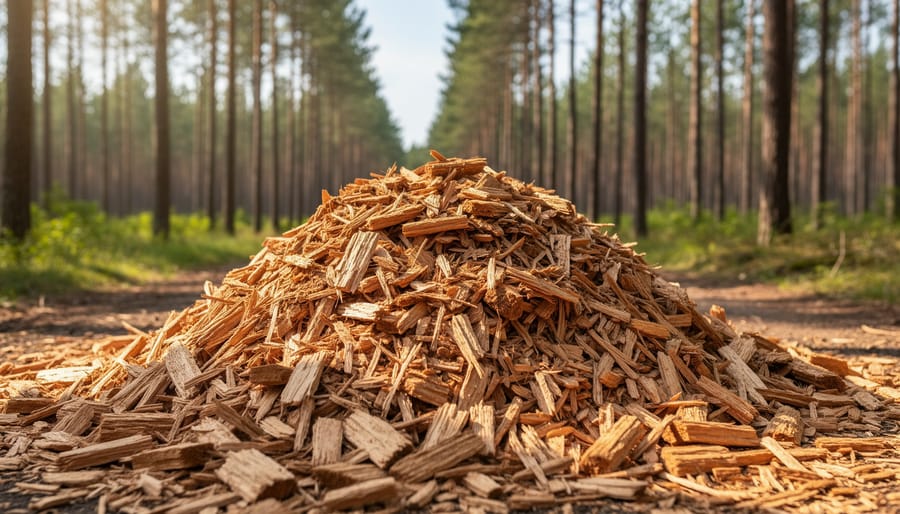
Sawmills and logging operations generate massive volumes of wood byproducts that once went to waste but now fuel Ontario’s biomass energy sector. Sawdust, bark strips, wood chips, and shavings accumulate daily at mills throughout the province, material too small or irregular for lumber but perfectly suited for energy production.
Most mills collect these forest residue materials through existing handling systems. Sawdust falls through floor grates into collection bins, while bark peels away during debarking and conveys to storage piles. Workers aggregate the material on-site, often using pneumatic systems or conveyor belts to move it from production areas to designated storage zones. The collection happens continuously as part of normal mill operations, requiring minimal additional labour.
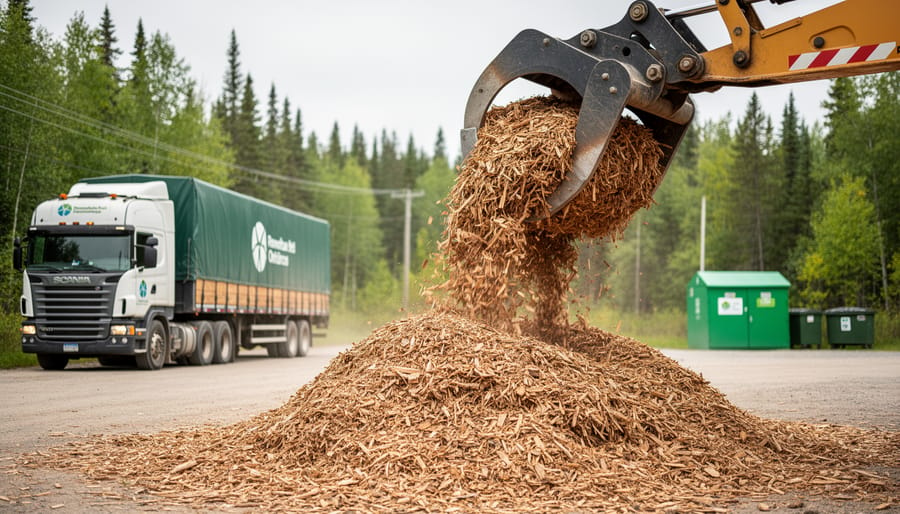
In the forest itself, logging crews gather branch tops, damaged wood, and undersized trees left after harvest. This material gets chipped on-site using mobile chippers, then trucked to biomass facilities or pellet plants. Ontario’s forestry operations typically collect residues within weeks of logging to prevent decay and maintain fuel quality. Some operations leave a portion on the forest floor to protect soil and support ecosystem health, balancing energy production with forest stewardship.
Sustainable Forest Management Practices
Ontario’s forestry sector follows strict sustainability protocols that govern how biomass is obtained from managed forests. The province requires forest companies to operate under approved Forest Management Plans that specify which trees can be harvested and in what quantities, ensuring forests regenerate naturally or through replanting programs. These plans undergo public review and must demonstrate that biomass collection maintains forest health, protects wildlife habitat, and preserves biodiversity.
Note: All Crown land forestry operations in Ontario must achieve third-party certification under standards like FSC or SFI, which independently verify sustainable harvesting practices.
Independent auditors regularly inspect harvest sites to confirm compliance with silviculture standards and regeneration requirements. This monitoring system tracks forest composition, growth rates, and ecological indicators across decades, creating accountability that extends far beyond individual harvest operations. By linking biomass collection to long-term forest stewardship, Ontario ensures that today’s energy production doesn’t compromise tomorrow’s forest resources or the ecosystem services they provide to communities across the province.
Agricultural Biomass Collection Methods
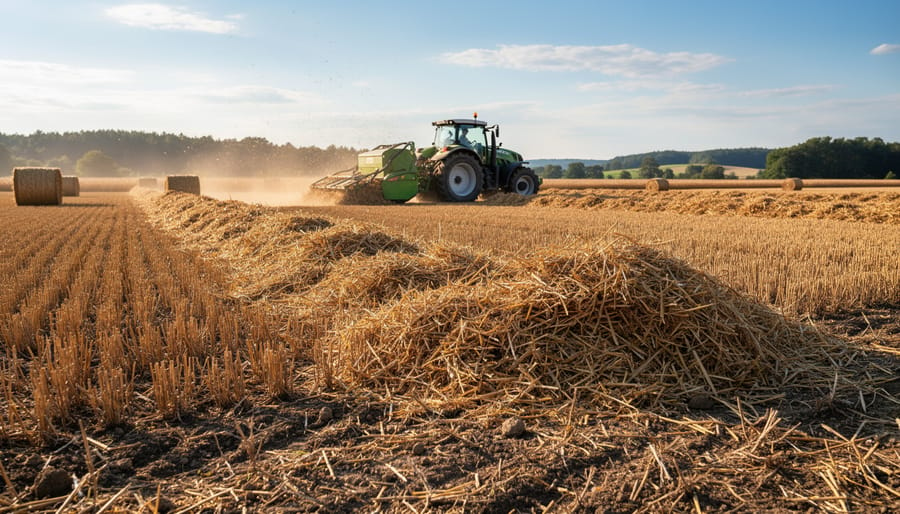
Ontario farmers collect agricultural biomass through several methods tailored to crop type and season. After corn harvest, combines equipped with special attachments chop stalks and spread residue evenly across fields, where farmers later bale the dried material for energy use. Collection timing matters: most crop residue gathering happens in late fall, when moisture content drops to 15-20% and reduces transportation costs.
Wheat and oat straw follow a different pattern. Farmers bale straw immediately after grain harvest in August and September, storing it in covered bunkers before shipping to biomass facilities. Ontario producers typically leave 30-40% of crop residues on fields to maintain soil health and erosion control, a practice mandated by provincial agricultural guidelines.
Animal waste collection operates year-round on dairy and livestock farms. Manure scrapers and vacuum systems transfer waste from barns to storage tanks, where it ages before solid-liquid separation. The solid portion becomes combustible biomass fuel, while liquids return as fertilizer. Several Southwestern Ontario dairy operations now partner with local biomass plants, creating a closed-loop system that turns farm waste into renewable energy.
Dedicated energy crops like switchgrass and miscanthus grow specifically for biomass production. Farmers plant these perennials once and harvest annually for 10-15 years using standard hay equipment. Peak harvest runs from November through January, when plants naturally dry down and nutrient content moves back to roots.
Farmer participation has grown steadily since 2018, when Ontario introduced incentive programs covering equipment costs and guaranteeing minimum prices. Over 300 farms across Eastern and Southwestern Ontario now supply agricultural biomass to energy facilities, turning what was once field waste into revenue while supporting the province’s clean energy targets.
Municipal and Industrial Organic Waste Diversion
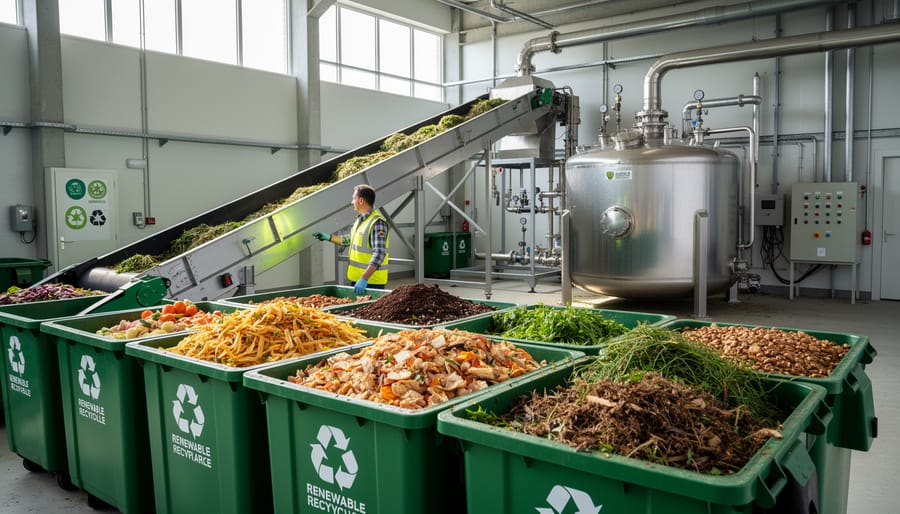
Cities across Ontario are transforming household and business waste into energy feedstock through organized organic waste diversion programs. The Green Bin system, now operating in Toronto, Ottawa, Peel Region, and other municipalities, separates food scraps, yard waste, and compostable materials at the source before collection trucks transport them to processing facilities. These programs keep thousands of tonnes of organic matter out of landfills annually while creating a steady biomass supply.
Ontario communities are capturing diverse organic waste streams for conversion to energy:
- Food waste from restaurants, grocery stores, and institutional kitchens
- Yard trimmings, leaves, and grass clippings from residential properties
- Food processing residues from manufacturing facilities
- Expired products and organic material from distribution centers
- Soiled paper and compostable packaging materials
The City of Guelph’s Wet-Dry Program stands out as a successful model. Residents separate all organic waste into one stream and everything else into another, achieving over 60% waste diversion. The collected organic material feeds into anaerobic digestion systems that generate both biogas for electricity and nutrient-rich compost.
Industrial operations contribute substantial volumes too. Breweries, food manufacturers, and pulp and paper mills generate organic byproducts that once went to waste. These businesses now partner with biomass facilities, turning spent grain, vegetable trimmings, and sludge into energy inputs. The arrangement cuts disposal costs for companies while providing processing plants with consistent, high-quality feedstock.
Collection logistics matter considerably. Separate trucks with sealed containers prevent contamination and odours during transport. Facilities receive deliveries daily, processing material quickly to maintain quality and prevent decomposition before energy conversion begins.
Processing Raw Biomass for Energy Use
Once collected, raw biomass can’t go straight into a power plant or heating system. Most materials need processing to reduce moisture, standardize size, and increase energy density, transforming bulky forest residues or wet agricultural waste into efficient, storable fuel.
Drying is often the first step. Freshly harvested wood can contain 50% moisture or more, which lowers combustion efficiency and releases more emissions. Ontario processors use natural air-drying in covered piles or mechanical kilns to bring moisture content down to 10-20%, depending on the intended use. Agricultural residues like corn stover and straw typically arrive drier but still benefit from further conditioning.
Size reduction comes next. Wood chippers and grinders break down logs, branches, and mill waste into uniform chips, typically one to three inches. This consistent sizing ensures even burning in power facilities and makes transportation more efficient. Agricultural materials pass through hammer mills or shredders that produce similarly standardized pieces.
Pelletizing creates the highest-density biomass fuel. Processors force dried, ground material through heated dies under intense pressure, binding the particles without additives. The resulting pellets flow like grain, store easily, and burn predictably, qualities that make them popular for both industrial boilers and residential heating across Ontario. Some facilities also produce briquettes or cubes for specialized applications.
Several Ontario communities host processing facilities that handle local biomass streams, creating stable employment while turning regional waste into valuable energy products. This processing infrastructure makes biomass viable as a reliable, year-round fuel source rather than a seasonal byproduct.
Community Impact: Who Benefits From Biomass Collection
Biomass collection delivers tangible benefits to Ontario communities, creating employment opportunities and economic activity in regions that need them most. Small-town sawmills that once burned wood waste or paid for disposal now sell residues to energy facilities, turning a cost center into revenue. Farm families earn supplemental income by baling crop residues after harvest or allowing energy crop cultivation on marginal land unsuitable for food production.
The employment impact extends beyond collection itself. Truck drivers transport biomass materials, equipment operators maintain chipping and baling machinery, and facility technicians ensure processing runs smoothly. In Northern Ontario municipalities like Atikokan, the Thunder Bay Generating Station’s conversion to biomass created dozens of long-term jobs in fuel handling, maintenance, and operations while supporting forestry workers who supply wood pellets.
Rural economic multipliers matter. Money spent on biomass collection circulates through local businesses: equipment dealers, repair shops, fuel stations, and restaurants. When Ontario Power Generation partners with Indigenous communities for sustainable forest management and biomass supply, the benefits include skills training, business development opportunities, and revenue sharing that supports community infrastructure.
Agricultural producers particularly benefit from diversified income streams. Livestock operations transform manure management from an environmental challenge into an energy asset through anaerobic digestion, generating electricity while reducing odour and nutrient runoff. Cash crop farmers participate in biomass supply chains during traditionally quiet seasons, smoothing income throughout the year.
These local benefits align Ontario’s clean energy future with community prosperity, demonstrating how renewable energy infrastructure can strengthen rather than bypass rural economies. The distributed nature of biomass collection ensures benefits spread across regions rather than concentrating in urban centers.
Ontario’s biomass collection network demonstrates how diverse sourcing methods can work together to support clean energy goals. From forestry operations capturing mill residues to farmers contributing crop waste and municipalities diverting organic materials, each collection pathway plays a specific role in building a sustainable fuel supply. These methods matter because responsible sourcing protects forest ecosystems, supports rural employment, and ensures biomass remains a genuinely renewable resource rather than depleting natural systems.
The province’s approach to obtaining biomass continues evolving as energy technologies improve and collection practices become more efficient. As Ontario works toward its 2050 net-zero targets, biomass sourced through sustainable methods will complement solar, wind, and hydroelectric power in the energy mix. The key lies in maintaining rigorous standards for how this fuel is collected, ensuring that today’s biomass harvesting strengthens rather than compromises tomorrow’s environmental health. Communities participating in these collection programs aren’t just supplying fuel, they’re actively shaping Ontario’s transition to cleaner energy.