
How Wind Energy Research Shapes Ontario’s Clean Power Future
Academic journals dedicated to wind energy serve as the critical bridge between laboratory research and the utility-scale turbines transforming Ontario’s electricity grid. These peer-reviewed publications document everything from advanced blade aerodynamics and grid integration strategies to wildlife impact assessments and community acceptance studies, offering policymakers and project developers the evidence base needed to make informed decisions about clean energy deployment.
For Ontario specifically, where wind power generated over 11% of provincial electricity in recent years, journal research has directly shaped how projects are sited, designed, and operated. Studies on turbine icing in cold climates, for example, have informed winter performance strategies across the province’s northern installations. Research into acoustic modeling has helped developers meet setback requirements while maximizing energy output. Economic analyses published in these journals provide the cost-benefit frameworks that municipal councils and provincial planners rely on when evaluating new wind farm proposals.
The knowledge published in wind energy journals moves quickly from theory to practice. When researchers identify a more efficient blade pitch control algorithm or a better method for predicting turbine wake effects, that information reaches engineers and operators within months, not years. Environmental impact studies clarify how turbines affect bird migration patterns or bat populations, giving wildlife biologists concrete data to work with rather than speculation.
Understanding what these journals cover and how their findings translate into real-world application matters for anyone involved in Ontario’s energy transition, whether you’re a student exploring renewable careers, a community member near a proposed wind farm, or a professional shaping the province’s clean electricity future.
Key Takeaway: Academic wind energy research directly addresses Ontario’s unique challenges by providing evidence-based solutions for winter performance, regulatory optimization, wildlife protection, and community engagement that developers can immediately apply to real projects.
What the Journal of Wind Energy Reveals About Current Industry Trends
Peer-reviewed wind energy research documents an industry in rapid transformation. Recent journals spotlight four interconnected themes that directly influence how Ontario and other regions build their wind capacity: steady turbine performance gains, the expansion into deeper waters, smarter grid integration techniques, and more refined environmental impact assessments.
Turbine efficiency remains a dominant research focus. Studies track design advances improving efficiency through larger rotor diameters, taller hub heights, and aerodynamic blade profiles that extract more energy from variable wind speeds. For Ontario’s land-based projects, these improvements translate to higher capacity factors even at moderate wind sites, making previously marginal locations economically viable.
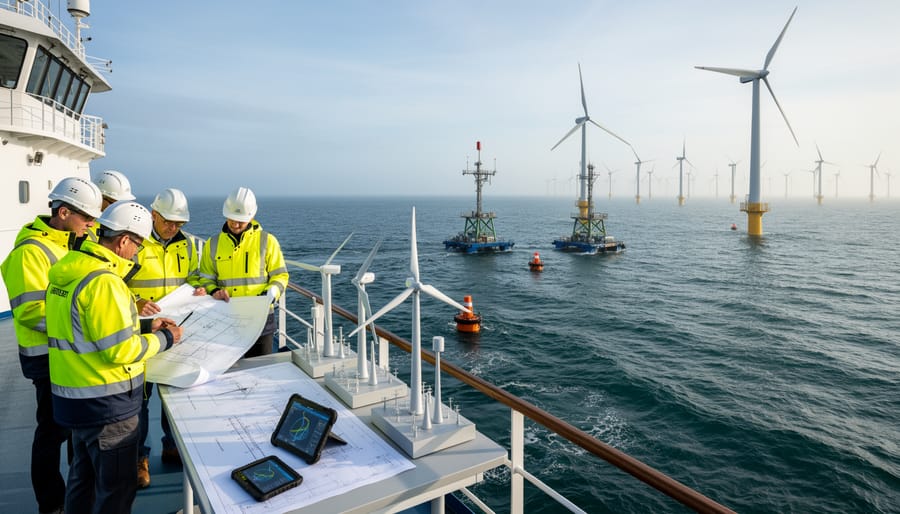
Offshore wind research has shifted toward floating offshore wind commercialization examining how platforms can harness stronger, steadier winds in waters too deep for fixed foundations. While Ontario’s Great Lakes wind potential remains underutilized, this research stream offers templates for overcoming the technical and regulatory complexities of freshwater installations.
Grid integration studies address the practical challenge of matching wind’s variability with electricity demand. Recent work explores short-term forecasting accuracy, battery storage pairing, and curtailment reduction strategies, all critical for Ontario’s grid operator as wind supplies an increasing share of provincial power.
Environmental research has grown more granular. Instead of broad impact claims, current studies quantify specific wildlife interactions, measure actual noise propagation across varied terrain, and document community perception shifts over time. This evidence-based approach helps Ontario developers design projects that minimize ecological disruption while maintaining strong local support.
Together, these research threads create a roadmap for addressing the real constraints facing Ontario’s wind sector, turning laboratory findings into deployable solutions that accelerate the province’s clean energy transition.
Technical Innovations Emerging from Wind Energy Research
Next-Generation Turbine Technologies
Academic journals document a rapid evolution in turbine design that holds particular promise for Ontario’s wind sector. Researchers are testing turbines with rotor diameters exceeding 250 meters, nearly double the size of current provincial installations, which capture significantly more energy at lower wind speeds. These new wind technologies achieve capacity factors above 60% in optimal conditions, compared to the 30-35% typical of older Ontario turbines.
Materials science breakthroughs feature prominently in recent publications. Carbon fiber composites and thermoplastic resins reduce blade weight while increasing strength, allowing longer blades that withstand Ontario’s winter ice loads and temperature fluctuations. Some studies explore modular blade designs that simplify transportation through rural Ontario roads where oversized components create logistical headaches.
Floating offshore platforms represent another research frontier, though their immediate relevance to landlocked Ontario remains limited. However, the engineering principles, dynamic load management, mooring systems, and installation methods, inform how researchers approach unconventional sites like old industrial waterfronts or areas with challenging soil conditions.
Sensor integration and digital twin modeling now allow turbines to self-optimize in real time, adjusting blade pitch and yaw based on wind patterns. This predictive capability, detailed extensively in recent journal articles, hints at what’s coming next: turbines that learn from their environment and maximize output without constant human intervention.
Smart Grid Integration Solutions
Wind energy journals extensively document grid integration solutions that Ontario researchers and utilities rely on to manage variable renewable generation. Energy storage research demonstrates that pairing wind farms with battery systems, particularly lithium-ion installations ranging from 20 MW to 250 MW, can smooth output fluctuations and provide ancillary grid services. Studies show these hybrid projects can increase effective capacity value by 15-25% while reducing curtailment during low-demand periods.
Demand response research explores how time-of-use pricing, industrial load shifting, and smart home technologies can align electricity consumption with wind availability. Recent Ontario-focused studies indicate that coordinating large industrial consumers with wind forecasts could reduce grid balancing costs by 8-12% annually.
Note: Ontario’s interconnected grid with neighbouring jurisdictions creates unique opportunities for these solutions to export excess wind power during high-generation periods while importing baseload when needed.
Forecasting methodology improvements documented in journals have dramatically reduced prediction errors. Advanced machine learning models now achieve wind power forecasts with 10-15% mean absolute error at 24-hour horizons, compared to 20-30% a decade ago. These forecasting gains enable grid operators to schedule conventional generation more efficiently, reducing backup requirements and operational costs. Research also examines virtual power plant concepts that aggregate distributed wind resources with other renewables, creating dispatchable capacity blocks that behave more predictably than individual installations.
Environmental and Community Impact Research
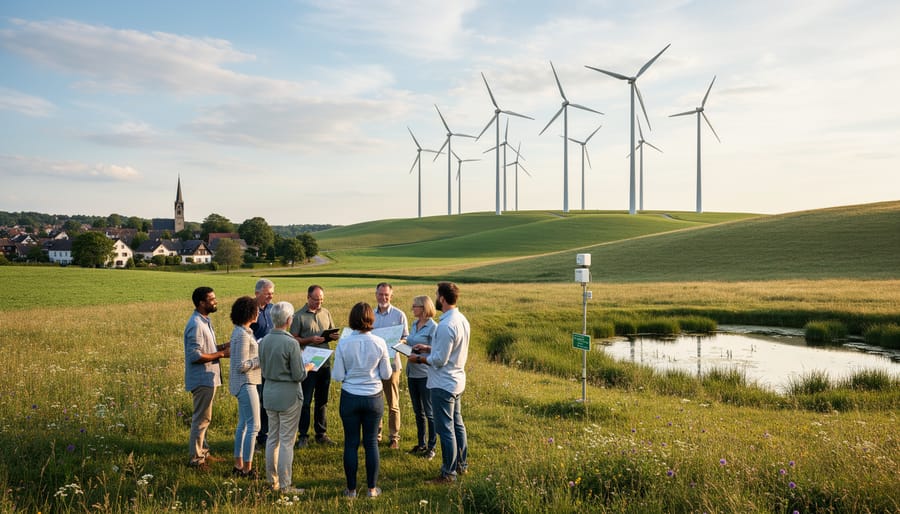
Peer-reviewed research has systematically examined the environmental and social dimensions of wind energy development, providing evidence-based guidance for minimizing impacts and fostering community support. These studies address concerns that frequently arise during wind farm planning processes in Ontario and other jurisdictions.
Wildlife impact research has focused primarily on bird and bat collisions with turbines. Studies consistently show that fatality rates vary significantly by location, species composition, and turbine placement. Research published in ecology and energy journals demonstrates that pre-construction site assessments, seasonal shutdown protocols during migration periods, and strategic turbine siting away from critical habitats can reduce wildlife mortality by 50-80%. Bat populations face particular vulnerability during late summer and autumn migration, prompting researchers to develop acoustic deterrents and curtailment strategies that balance energy production with conservation goals.
Noise studies have measured both audible sound and low-frequency components at various distances from operating turbines. Field measurements typically record sound levels of 35-45 decibels at 300-500 meters, comparable to a quiet library or rural nighttime environment. Research indicates that individual sensitivity varies considerably, and factors like terrain, existing ambient noise, and community engagement during planning influence perception and acceptance more than absolute sound levels alone.
Visual impact research examines landscape aesthetics, viewshed analysis, and cultural heritage considerations. Studies in environmental psychology reveal that attitudes toward turbine visibility correlate strongly with overall support for renewable energy and perceived fairness in siting processes. Communities involved early in planning discussions generally report higher acceptance rates regardless of visual proximity.
Community acceptance research identifies transparency, local economic benefits, and procedural justice as critical factors. Studies show that projects offering community ownership opportunities, employment, or direct revenue sharing achieve substantially higher local support than those perceived as externally imposed developments serving distant urban centers.
Economic Viability Studies and Cost Reduction Pathways
Wind energy journals document a remarkable economic transformation: the levelized cost of energy (LCOE) from wind has dropped by over 70% since 2010, making it one of the cheapest electricity sources available. Research published in these journals reveals how economies of scale, technological improvements, and competitive procurement processes have driven this shift, fundamentally changing how utilities and policymakers view wind power.
| Cost Factor | 2010 Baseline | 2020-2026 Range | Primary Driver |
|---|---|---|---|
| Turbine CAPEX ($/kW) | $1,800-2,200 | $900-1,300 | Manufacturing scale, larger units |
| Capacity Factor (%) | 25-35 | 40-50 | Taller towers, longer blades |
| O&M Costs ($/MWh) | $12-18 | $7-12 | Predictive maintenance, reliability |
| LCOE ($/MWh) | $80-120 | $30-60 | Combined improvements |
Economic modeling studies show that capacity factor improvements deliver outsized returns, as higher output from the same capital investment directly reduces per-unit costs. Research tracks how hub heights have climbed from 80 meters to 120 meters or more, accessing stronger and steadier winds that boost annual energy production by 20-40%. These gains compound with turbine upsizing, where 5-megawatt and larger machines spread fixed costs across greater output.
Journal analyses also examine soft costs like permitting timelines, interconnection delays, and land lease negotiations. Studies find that streamlined approval processes and standardized contracts can shave 10-15% off project development expenses. For Ontario, where regulatory pathways have evolved since early wind farm debates, this research offers concrete benchmarks showing how administrative efficiency translates into lower electricity prices.
Financing cost research highlights that wind projects now secure debt at rates comparable to conventional generation, reflecting lenders’ confidence in proven technology and stable revenue streams. The combination of lower capital costs, higher performance, and favorable financing creates a compelling economic case that journals quantify with rigorous data, directly informing investment decisions across Ontario’s energy sector.
Ontario-Specific Research Contributions and Applications
Ontario’s research institutions have become significant contributors to wind energy knowledge, with findings that directly address the province’s unique deployment context. The University of Toronto, Western University, and Carleton University have published studies examining cold-climate turbine performance, ice accretion impacts, and winter efficiency losses, challenges particularly relevant to northern and inland wind sites across the province. This research has informed turbine selection criteria and anti-icing strategies that Ontario developers now routinely incorporate into project planning.
Work from the University of Waterloo’s Wind Energy Group has focused on wake effects and optimal turbine spacing for Ontario’s typical wind farm layouts, helping maximize energy capture while minimizing interference between turbines. Their modeling studies have influenced site design practices at several southwestern Ontario facilities, demonstrating how academic research translates into measurable capacity factor improvements.
Ontario’s Independent Electricity System Operator has collaborated with researchers on grid integration studies specific to the province’s electricity market structure. This partnership has produced insights on balancing wind variability with Ontario’s nuclear baseload and hydroelectric flexibility, shaping dispatch protocols and curtailment policies that maintain system reliability while accommodating renewable generation.
Environmental research conducted at institutions like Trent University has examined wind farm impacts on bird migration patterns along the Great Lakes corridor and bat populations in forested regions. These studies have directly informed Environment and Climate Change Canada’s screening guidelines and helped developers implement evidence-based mitigation measures for Ontario clean energy projects.
The province’s research output extends to economic analyses examining wind power’s role in decarbonizing industries and communities. Studies from Queen’s University have modeled wind energy integration with electric vehicle charging infrastructure and industrial electrification pathways, providing roadmaps that align with Ontario’s broader climate commitments and energy transition goals.
How This Research Addresses Real-World Development Challenges
Ontario’s wind sector faces distinct implementation hurdles that academic research helps overcome. When developers encounter resistance to new wind projects, studies on community acceptance strategies provide frameworks for meaningful public consultation rather than token engagement. Research documenting successful co-ownership models and benefit-sharing agreements gives municipalities concrete alternatives to traditional development approaches, turning skeptics into stakeholders.
Regulatory complexity slows projects across the province, but research on streamlined permitting processes in other jurisdictions offers templates Ontario policymakers can adapt. Studies quantifying actual versus perceived environmental impacts give regulators data-driven baselines for setting appropriate setback distances and noise limits, replacing precautionary extremes with science-backed standards.
Winter climate presents technical challenges unique to Ontario’s latitude. Journal articles examining turbine performance in cold climates inform blade heating system specifications and ice detection protocols that prevent downtime during peak heating demand periods. This research validates operational strategies that maximize generation when electricity prices typically spike.
Land use conflicts emerge where prime agricultural areas intersect with strong wind resources. Spatial analysis research helps planners identify optimal sites that balance energy output with farmland preservation, while soil compaction studies demonstrate that modern turbine foundations occupy minimal productive area. Wildlife impact research guides seasonal construction timing and turbine placement that protects migratory bird corridors.
The future wind outlook depends on translating these research findings into practical developer guidelines, updated regulations, and community engagement protocols that accelerate deployment while maintaining environmental standards. Academic journals don’t just document challenges, they provide the tested solutions Ontario needs now.
The knowledge emerging from wind energy journals translates directly into Ontario’s capacity to build a cleaner, more resilient power grid. Each peer-reviewed study on turbine efficiency, grid integration, or environmental mitigation provides practical tools that developers, policymakers, and communities can apply to real projects across the province.
Ontario’s wind sector has already benefited enormously from research-driven improvements in turbine design, forecasting accuracy, and cost reduction strategies. The province now generates substantial clean electricity from wind, displacing fossil fuel generation and creating economic opportunities in rural communities. Yet significant challenges remain. Integrating higher percentages of variable renewable power, addressing legitimate community concerns, navigating complex regulatory processes, and optimizing wind farms for Ontario’s specific climate conditions all require ongoing research and innovation.
Continued investment in wind energy research through academic institutions, industry partnerships, and government-supported programs ensures Ontario stays at the forefront of clean energy deployment. The findings published in specialized journals today become the standard practices of tomorrow, accelerating the province’s transition toward a sustainable energy future.
By supporting and applying this research, Ontario can overcome current development barriers, maximize the benefits of wind power, and establish itself as a leader in renewable energy innovation that other jurisdictions can follow.